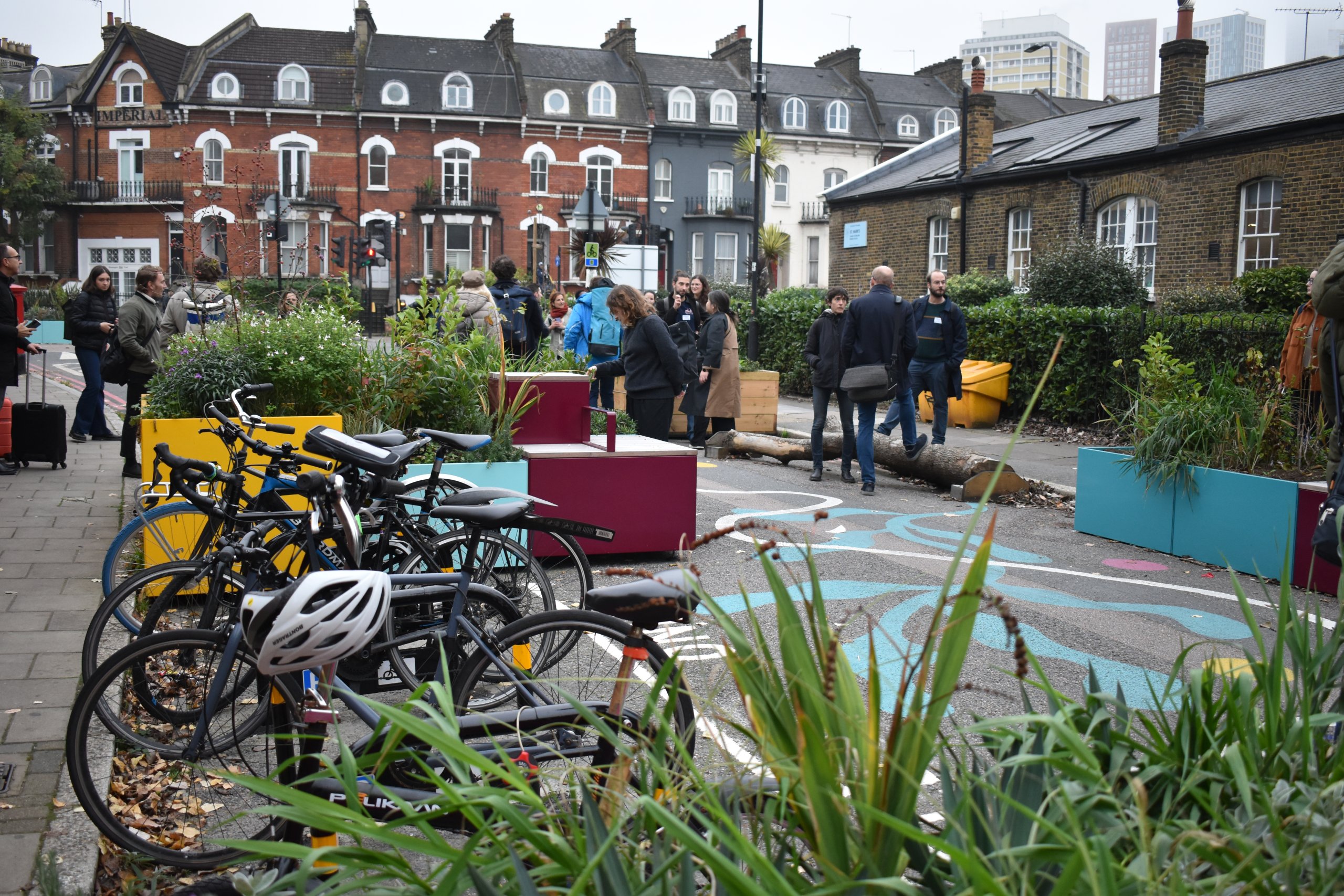

Exciting news for London’s environment and future resilience!

17th March 2026 / Posted by Fiona Coull

The Greater London Authority has launched two major tools to help shape a greener, more climate resilient city: the London Green Infrastructure Framework (LGIF) and London’s first Local Nature Recovery Strategy (LNRS). Together, these spatial tools provide a powerful evidence base to guide how we plan, invest in, and manage London’s green and blue spaces. 

What is the LGIF? 

The London Green Infrastructure Framework is an interactive, map based tool that brings key London-wide data on green infrastructure (GI) into one place. It helps users: 

  • Identify where new or improved GI can deliver the greatest benefits 
  • Understand opportunities for climate resilience, nature recovery and community wellbeing 
  • Pinpoint priority areas for creating or enhancing green and blue features 

What is the LNRS? 

London’s Local Nature Recovery Strategy includes a written plan and a mapped set of opportunities for restoring nature. Developed with input from Londoners and local organisations, it: 

  • Highlights the areas where nature most needs support 
  • Sets out priority actions for recovery 
  • Identifies opportunity zones where interventions can have the biggest impact 

How can these tools support you? 

For local authority planners:
Use the LGIF and LNRS to shape local plans, assess development proposals, and target GI investment where it’s most needed. 

For community groups:
Explore local opportunities for nature recovery, design meaningful projects, and use the evidence base to strengthen funding bids. 

For landowners and site managers:
Inform land management decisions, design greener developments, and create spaces that support nature, climate resilience and local communities. 

Find out more on the GLA website here! 

Explore CRP’s New Wider Networks Page!

17th March 2026 / Posted by Katie Smith

CRP is delighted to launch our brand‑new Wider Networks webpage, a dynamic showcase of the organisations and experts who power and enhance our work. While our long‑standing CRP partners remain central to everything we do, this new page celebrates the growing networks across London, the UK and internationally that help us amplify our impact. 

Collaboration is at the heart of CRP’s mission, and our expanding wider networks reflect the diverse and innovative organisations working with us to deliver sustainable, community‑focused solutions for places and people. 

Our academic partners, including University College LondonImperial CollegeKings College London and University of Westminster., provide vital research and insight. 

We engage with major landowners such as The Portman Estate and British Land to create greener, people‑focused spaces, and maintain strong links with Department for TransportDefra and Department for Business & Trade to align our work with national sustainability and transport priorities. 

Internationally, partnerships with organisations such as  C40 Cities and ALICE Logistics enable valuable knowledge exchange and help extend CRP’s impact beyond the UK. 

We collaborate with leading healthcare institutions including Great Ormond Street Hospital and Guys and St Thomas Hospital to support healthier communities. 

Our work with tech innovators like Grid Smarter Cities and Vivacity brings digital tools and data‑driven insights into our projects, while logistics partners, from EVRI to Delivery Mates, help us trial cleaner, smarter delivery solutions. 

We also continue to grow our network of businesses, charities and community groups, helping shape more inclusive and thriving neighbourhoods. 

👉 Visit the new CRP Wider Networks page to explore the full picture and discover how collaboration shapes our mission. 

TfL Spotlights CRP’s London Light Freight Walking Trial

17th March 2026 / Posted by Katie Smith

Transport for London has released a new collection of case studies highlighting pioneering approaches to sustainable logistics across the capital and we’re delighted that our London Light Freight Walking Trial has been featured.  

Completed in 2024, this project explored whether walking freight couriers using electric assisted trolleys (e-walkers) could provide a cleaner, more efficient last-mile delivery option in busy, pedestrian areas. 

Led by Cross River Partnership (CRP), the 10-month Defra funded trial was delivered in collaboration with The Fitzrovia Partnership, Camden Council, UPS and Heal’s.  

TfL’s case study highlights several important insights, including: 

  • Walking freight offers a practical supplement to traditional delivery vehicles. 
  • E-walkers provide a low-emission, cost effective solution for short, local delivery routes. 
  • Couriers reported that e-walkers were easier, quicker and more practical when delivering in dense or challenging urban environments. 

We’re proud to see this innovative CRP project recognised by TfL as part of London’s growing body of evidence on sustainable logistics.  

Read the full case study here: Walking freight trial case study

CRP has a strong track record in bringing innovative, sustainable urban logistics to life — from pioneering walking freight and rolling out parcel locker networks, to testing logistics hubs and trialling river freight solutions. If you’re looking to make your organisation’s deliveries cleaner, smarter and more efficient, we’d love to hear from you. 

Contact CRP’s Fiona Coull to explore what we can achieve together! 

Partner Spotlight: Islington’s Electric Future

17th March 2026 / Posted by Isidora Rivera Vollmer

We are delighted to share some fantastic news from our partners at Islington Council, who have successfully secured £932,500 in government funding to supercharge the borough’s electric vehicle (EV) infrastructure. Part of a wider £1.86 million pot shared with Camden Council, this investment from the Department for Transport’s Local EV Infrastructure (LEVI) Fund will be matched by significant private investment to create a cleaner, healthier transport network. 

Islington has already delivered over 600 publicly accessible charge points, but this additional capital will allow for a massive expansion. Between 2026 and 2030, the council plans to install at least 840 new points, including 600 lamp column chargers and 240 fast charge points. This boost supports the council’s ambitious goal of providing more than 1,400 on-street EV charge points across the borough by 2030. 

Councillor Rowena Champion, Executive Member for Environment, Air Quality and Transport, noted that by putting this infrastructure in place now, the council is making it easier for drivers to ditch petrol and diesel, ultimately improving local air quality.  

With procurement strategies expected to be finalised in spring 2026, this project perfectly aligns with Cross River Partnership’s mission to support sustainable logistics and cleaner air across London. We look forward to seeing these chargers hit the streets soon! 

Read the full press release here: https://www.islington.media/news/powering-forward-with-nearly-gbp-1m-funding-for-electric-vehicle-charging  


CRP Consultancy Services

17th March 2026 / Posted by Susannah Wilks

CRP is proud to have expanded our Consultancy Services offering this year, with five completely new consultancy client commissions, from Better Bankside BIDGuys and St. Thomas’ Trust and UCL. 

We have been very pleased to bring our knowledge, expertise, skills and experience gained from up-to-the-minute grant-funded project delivery to bear on our consultancy commissions.  This lends real strength and depth to the services and advice that we are able to offer, across topics including: 

  • Decarbonisation and Sustainability 
  • Placemaking and Greening 
  • Strategy Planning 
  • Monitoring and Data Analysis 
  • Partnership and Stakeholder Engagement 

For further information please contact CRP Senior Programme Manager Fiona Coull.

Oxford Street Pedestrianisation

17th March 2026 / Posted by Susannah Wilks

Westminster Extra recently published an article outlining the new plans for the pedestrianisation of Oxford Street.

From this summer traffic is set to be banned within a mile of oxford street, the Mayor of London has confirmed. He has outlined new plans to turn the landmark shopping area into a hub for “world‑class events”.

Sadiq Khan announced that he has directed his team to accelerate work on fully pedestrianizing the stretch between Oxford Circus and Orchard Street. The move was enabled after the Mayor secured government approval to take over local planning powers for the site.

Once implemented, the scheme will block access for all motor vehicles including buses, taxis, private‑hire cars, and pedicabs, as well as bicycles and scooters. The redesign will also introduce a dedicated events space intended to generate additional income.

Westminster Council had previously advanced its own proposals for improvements along Oxford Street.

The Mayor said that 2,700 people took part in the public consultation, with most respondents supporting the plan to remove traffic. “Following strong support from Londoners and businesses, I’ve asked the team to move at pace with plans to pedestrianise Oxford Street this summer so we can deliver a vibrant, world-class, accessible destination,” Sir Sadiq said. 

Clearly the devil will be in the detail, but no one doubts the need to re-establish Oxford Street as the jewel in central London’s crown. 

For more information on this see the Mayor gets his way on Oxford Street! | Westminster Extra from Westminster Extra.


CRP’s Visit to the Southwark Urban Logistics Site

23rd February 2026 / Posted by Isidora Rivera Vollmer

Our recent visit to British Land’s new multi-storey Southwark Urban Logistics site with Aver PR offered a fantastic look at how London’s logistics spaces are evolving.  


The site features a range of potential units, designed with high ceilings and key infrastructure like three-phase power to support modern e-cargo bike and EV logistics operations. It was encouraging to see practical additions such as blue roofs alongside improved staff facilities like a kitchen and office spaces, which are becoming vital for the next generation of urban logistics hubs. 


We spent time discussing the operational side of these developments, from tenant vetting to the integration of large-scale couriers with sustainable last-mile solutions.  


If you are currently navigating site feasibility or looking for ways to implement low-emission delivery strategies, we are here to help you make sense of these options. We have the network and the expertise to help you find the right fit for your operations, so please do get in touch if you’d like to chat about a specific project! 

CRP Shares Insights from the First Pathways to Net Zero Conference

23rd February 2026 / Posted by Katie Smith

Cross River Partnership (CRP) joined transport, planning and sustainability leaders in Birmingham last month for the inaugural Pathways to Net Zero conference, hosted by Landor Links. The event brought together experts from across the UK to explore how the transport sector can accelerate progress towards achieving a net zero network by 2050. 


The conference delivered a packed agenda of forward‑thinking discussions and practical case studies on policies, partnerships and innovations required to cut emissions at scale. A key takeaway was the recognition that achieving net zero requires a whole‑system approach, balancing technology, behaviour change, integrated planning, and long‑term investment – particularly as demand on the transport network continues to grow. 


It was also encouraging to see discussions around the future of freight, which plays a critical role in decarbonisation but faces complex challenges across roads, logistics, and last‑mile delivery. There was recognition of the vital role rail freight can play in cutting transport emissions. 


At CRP, we’re proud to be part of that shift through our innovative work and ambitions for Waterloo Freight Hub, showcasing how low‑carbon urban freight solutions can be transformative!  


Read more about our work to deliver the award-winning Waterloo Freight Hub trial, and future ambitions here: The Waterloo Freight Hub – Cross River Partnership

CRP Attends Camden Town Unlimited Co-design Session

23rd February 2026 / Posted by Katie Smith

Over the past few months, a series of innovative co‑design workshops led by CRP Partner Camden Town Unlimited have been transforming how local people imagine the future of Camden High Street. This has been delivered as part of CRP’s Healthy Streets Everyday II (HSEII) programme. 


Sessions brought together paid neighbourhood designers, residents, businesses, and partners to help re‑envision the iconic high street in a way that complements its pedestrianisation and reflects the lived experience of those who use it every day. 


Rather than relying solely on traditional consultation methods, the workshops embraced hands‑on creativity and collaborative exploration. Each workshop moved well beyond discussion, encouraging participants to engage with the street and with each other in imaginative and person‑centred ways such as: 

  • Exploring personal objects to uncover individual memories, connections, and meanings tied to Camden High Street. 
  • Using photography to document how people see, interpret, and move through the space. 
  • Building physical models to test ideas and visualise the changes that matter most to local users. 


The co‑design process is central to creating an environment that supports walking, wheeling, and cycling, making active travel easier, safer, and more enjoyable. By designing around real patterns of movement and use, the project aims to enable long‑term behaviour change.  


To learn more about our HSEII Projects, visit: Healthy Streets Everyday II – Cross River Partnership

Air Pollution Joins Europe’s List of Proven Cancer Risks

23rd February 2026 / Posted by Ross Phillips

Air pollution has now been formally recognised as a cancer risk in Europe for the first time, after being added to the latest edition of the European Code Against Cancer 


Recommendations outlined in the report encourage individuals to: 

  • Limit their exposure by choosing public transport, walking or cycling instead of driving 
  • Choose low-traffic routes when exercising outdoors 
  • Keep homes free of smoke by avoiding the burning of coal or wood.  


Cross River Partnership has a wide range of programmes that improve air quality by shifting polluting vehicle journeys to active travel modes, helping to improve health outcomes and reduce cancer risk.  


These include Healthy Streets Everyday II, improving infrastructure in the public realm to create more spaces for walking, wheeling, cycling and scooting, and freight projects such as the Waterloo Freight Hub and London Light Freight River Trial, where parcel journeys by polluting van and lorry took place by electric cargo bikes or river vessels.   


The inclusion of air pollution in the European Code Against Cancer reflects the risk that is posed by local pollutants such as Particulate Matter and Nitrogen Dioxide on our health, and shows the continued need to address these challenges in cities across Europe.  


CRP is continuing to work closely with the health sector in delivering improved health outcomes from its innovative trials and projects across sustainability, placemaking, transport and freight.  


For more information or to hear more on our health and air quality work, please email Ross Phillips on rossphillips@crossriverpartnership.org